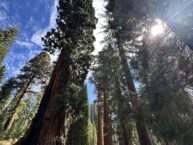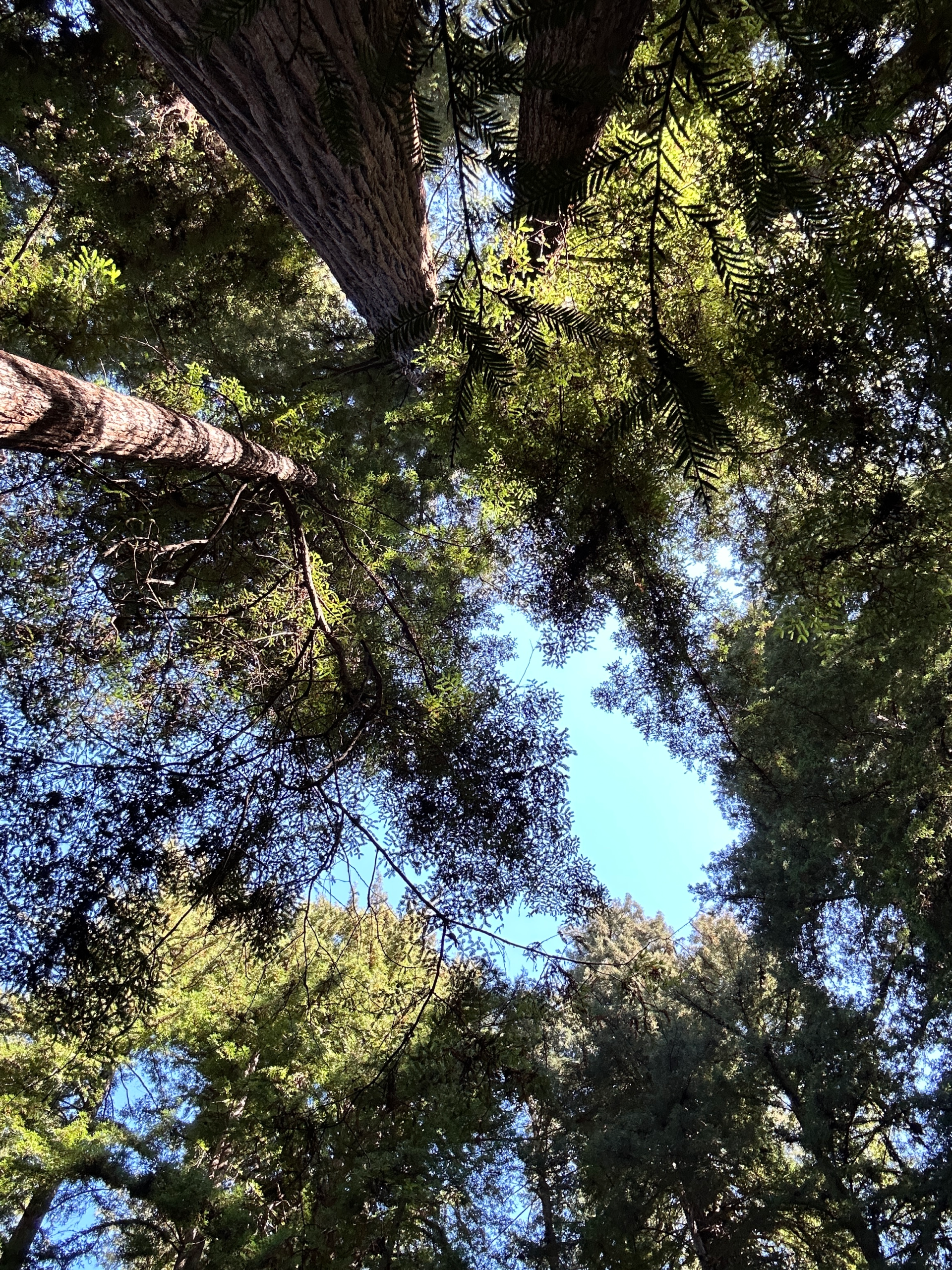
Redwoods in Henry Cowell State Park. PHOTO: DIANA WILCOX
October 25, 2026: May God’s words be spoken, may God’s words be heard. Amen.
So, last week on the Jesus Channel, the Pharisees teamed with their not-so-best-buds, the Herodians, to try to trip Jesus up with a question (after, of course, flattering him). They essentially said, “Hey Jesus – you are lookin’ mighty awesome and since we know you are the absolute bomb when it comes to, ya know, knowin’ stuff, we have a question for you…”. Then they asked him about whether it was legal to pay taxes to the emperor. We know from last week that this was a trap, and that Jesus wasn’t the least bit fooled.
And now for today’s episode, the Pharisees are at it again. A lawyer among them thought up a great question to test Jesus, or so he thought. Now, you’d think that with all the questions these folks have, they would be Episcopalians, but they aren’t interested in finding out anything new. How do we know that? Well, because they already know the answer – so does Jesus (obviously), and so does everyone else gathered around them.
See, unlike last week where they tried to give Jesus a no-win situation, thinking there was only two answers, they entered that situation unaware of the truth. This time, everyone is on the same page – everyone knows the truthful response to the question they pose “Which is the greatest commandment?”
They all know, because they are all Jewish – Jesus, the Pharisees, the disciples – all of them. And they know Torah, and the teachings of the great Rabbis. But Jesus answers them anyway, saying that the greatest commandment is “’You shall love the Lord your God with all your heart, and with all your soul, and with all your mind.’ This is the greatest and first commandment.
It isn’t that Jesus is choosing his words carefully or trying to determine the answer. He is quoting it verbatim from the scriptures. The first part is the Shema, the Jewish prayer of worship from Deuteronomy “You shall love the Lord your God with all your heart and with all your soul and with all your might.” Now our translation read today changes that last part from might to mind, however most do not. But might or mind, it means – with everything you’ve got. These Pharisees can’t argue with that one.
But wait, Jesus doesn’t end there. He continues and says “And a second is like it: ‘You shall love your neighbor as yourself.’” That is also a direct quote from that book everybody loves to read – Leviticus. Yup!
Then Jesus, for good measure, adds, “On these two commandments hang all the law and the prophets.” That there is a bit of an insider smackdown that those who are not learned Jews often miss. One of the greatest teachers of the faith, Hillel The Elder, who lived “a generation before Jesus, had said the same thing to a gentile who asked for the whole Torah summarized. After saying Shema, he answered, and: “That which is hateful to you, do not do to your fellow—this is the whole Torah; the rest is commentary.” Jesus is telling these Pharisees, these temple leaders, “Not for nuthin’ guys, but don’t you’all know this already?”
At about this point, I suspect they wanted to slink away. They really should have, because Jesus was about to drop the mic on them. He decides to ask them a question.
He says, essentially “So, let me get this straight…this Messiah you await… Whose son is he?”
They answered “The son of David.”
“Okay, well…why then does David call him Lord? I mean, if the Messiah is the son, why does the dad bend a knee to him?”
BOOM!
Those Pharisees didn’t know how to answer him, so they left and never came back to ask any more questions.
But I bet we have some.
What the heck was that second bit about David about and why did Jesus ask it at this particular time after answering the question about the greatest commandment so perfectly?
Well, to answer that, let me return to something I mentioned last week. That while on sabbatical I had the chance to
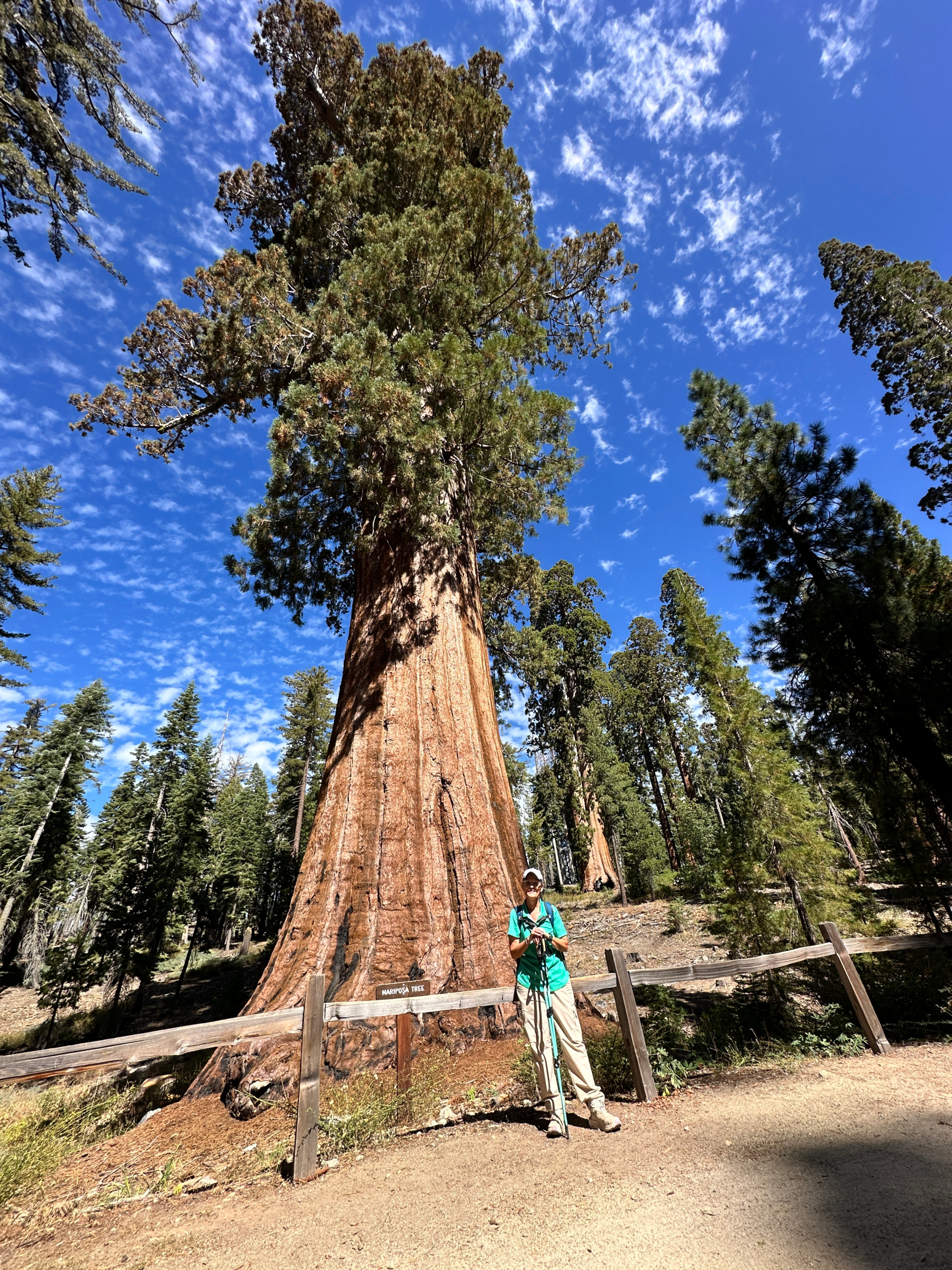
Mother Diana at the base of a sequoia while hiking the Mariposa Grove Trail, Yosemite.
go to California and stand amid the enormous sequoias of Yosemite, and the redwoods and Ponderosa pines of the Pacific coast. I knew beforehand that redwoods are only able to stand as tall as they do by intertwining their roots in a vast network of relationship. But that is only part of the story.
Before I left, I was reading a book by Suzanne Simard, a professor of forest ecology in the University of British Columbia’s Faculty of Forestry. In Finding The Mother Tree, Simard describes her logging family background, and her search to discover the effect of clear cutting on forest sustainability. The practice was to just plant new trees in fully cleared lands to replenish the forest. That sounds good, but it wasn’t working. The seedlings were looking sickly and not growing.
Thinking about this on her way back to her truck, she happened to dig up a truffle from the forest floor. She noticed the long fibrous strands connected to it, and was curious about it. She put it in her pocket and was continuing on, when she slipped down a small hill. As she was sliding, she grabbed a sapling, which yanked it from the ground, but slowed her fall. When she looked at it, she saw something very strange. “These root tips were glowing yellow, like lights on a Christmas tree, and they ended in a gossamer of mycelium of the same color.” It was the same color as what flowed from the root of the mushroom she had picked earlier.
The book tells the full story of her journey to discover the significance of this connection, but essentially she came to find that trees are not isolated plants. The mycelium was a life line between the truffle, the trees, and the rest of the plant life on the forest floor. In fact, nothing in the forest acts on its own. “Trees are a complex, interdependent circle of life, and forests are social, co-operative creatures connected through underground networks. Trees perceive one another, learn and adapt their behaviors, recognize neighbors, and remember the past…At the center of these vast networks are the Mother Trees: mysterious, powerful forces that connect and sustain those surrounding them.”[1]
We could learn a lot from trees.
They do naturally what Jesus is reminding the Pharisees and all of us. That being in relationship with the others around us, even those as different as a tiny mushroom would be to the grand redwood or sequoia, is not only a good thing, but life giving to all. The tree doesn’t say “I am taller and bigger and therefore better than that little thing growing in the dirt at my feet. Why should I care what happens to it.” It is the humility of the natural world – the world created by God, unspoiled by human ambition, greed, or hate. And it is the root (yeah, I did that) of how to live out the greatest commandments.
So, when Jesus asks the Pharisees about King David, a very flawed fellow himself, he is saying that even though David was the ruler of all of Israel & Judah, he knew that he was not greater than the Messiah, even if that Messiah was a descendent to him. Humility such as that of David was missing from these Pharisees, and they knew it the moment Jesus posed the question to them. And humility is the key to keeping the greatest commandments.
As one commentator noted, the great Christian theologian, “Thomas Aquinas defined love [this way] — to will the good of the other. Not to feel warmly toward the other. Not to tolerate the other. To actively, structurally, sacrificially orient your will toward the flourishing of another person […] It is a choice, made again and again, in the direction of someone else’s good.
But Aquinas understood something else as well. The will cannot orient itself toward the other if the self is still crowding the center. […] You cannot love, […] without first making interior room for the other person to matter as much as you do. That interior making room has a name. It is called humility.”[2]
These days though, it seems there are a whole lot of folks who seem to wake up every day singing that classic song of the late country-folk singer-songwriter, Mac Davis “Lord, it’s hard to be humble when your perfect in so many ways.” If you don’t know anyone like that yourself, then just read or watch the news. You are bound to hear about them.
We live in a world where, if humans were trees, we’d all be dead, because some of them would create a zero-sum game in the forest, without realizing that all lives depend on the others around us. While we are not trees, our arrogance instead leads us to just clear them out whenever they become inconvenient, even the Mother Trees. The President just did that in DC, against a court order, chopping down over 400 trees so he could change public parkland to a private golf course. The trees die, and God weeps.
So, to sum it all up: Jesus answers the Pharisees in the same way as Hillel The Elder taught, as all of the commandments of God taught, as all of the witness of the prophets taught, as all of scripture taught, and it boils down to this: Love God, Love Neighbor. And love is impossible if it is not paired with humility.
Humility, as the trees themselves show, doesn’t mean bending down or making oneself small. It is as Aquinas taught – to make room for others.
So, how do we do that?
Well first, we come here to this place, to connect with our Mother Tree – Christ – in the forest of our community – our parish family. Here our roots are connected not only with one another, but to the ancestors of this parish, the ones whose generous faith made it possible for us to be here now. Here we confess our sins too, so that we may always be able to make room to love.
Here too in this sacred place we experience the transcendent and the mysterious, and we remember that we are a part of something much larger than ourselves. We are part of the body of Christ, the communion of saints, the universal forest we call the Christian Church. The church whose foundation is the One whose great love for us we know not from the miraculous or the showy, but from his humility to kneel before his disciples to wash their feet and to give himself up on the cross.
By the example of his humility and love, we are all reminded what it means to follow him – what it means to live by the commandments of God – what it means to love.
And I have seen this at work in all of you over these many years together. You all demonstrate how to love God and neighbor in so many ways. In humility that you would never claim (because that would negate it) you tend to those who are struggling, visit the sick or imprisoned, and check-in on those who are alone.
You offer of your time to make the Eucharist possible by serving on Altar guild. You greet people at the door on Sundays as an Usher. You use your cooking or baking skills, or go to the store, to provide hospitality at our coffee hour. You ensure those who cannot hear are included, and those who do not know the language can understand. You offer healing prayer to those in need. You tend to our children in Sunday School, helping them to grow in faith.
You serve in leadership positions as Vestry members or Wardens, reviewing the finances, the buildings & grounds, and keeping up with the needs of the entire parish. You serve in worship ministries as crucifers and acolytes, or put in many hours each week to offer your voice and music talents in the choir. You have taken people to doctor appointments, stayed with them overnight, cleaned out refrigerators, brought over food, and so much more. This you all do every day, all year.
But you all also know that our proverbial forest is not just this parish, or even restricted to the church. All of God’s creation, all people, are a part of it, and if one part of that forest is hurt or sick or being cut down, we all suffer. So, you are out in the streets marching for justice. You raise donations for the hungry, the fearful, and animals in need. And you offer your prayer for peace around the world.
And so, in this Stewardship season, you will be given a gift blessed at the altar. Today it is a miniature pine tree.
Let it be a reminder of the life of trees and of our Mother Tree – Christ Jesus.
Let it help you to know that you are part of God’s forest and you are not in this alone – God, and all of us – your parish family – are with you tool
Let it set your heart and mind as well on how you might be a nourishing root to this parish by your pledge, so that we can continue to be a place that loves God, loves neighbor, and changes the world.
Amen.
For the audio, click below, or subscribe to our iTunes Sermon Podcast by clicking here (also available on Audible):
[1] From the book cover summary.
[2] Zina Jacque, Board Chair, National Senior Communities, Washington, D.C. at https://www.workingpreacher.org/commentaries/revised-common-lectionary/ordinary-30/commentary-on-matthew-2234-46-7
The Rev. Diana L. Wilcox
Christ Church in Bloomfield & Glen Ridge
October 25, 2026
Pent 20, Proper 25 – Year A – Track 1
Hebrew – Deuteronomy 34:1-12
Psalm 90:1-6, 13-17
Christian – 1 Thessalonians 2:1-8
Gospel – Matthew 22:34-46