 October 18, 2026: May God’s words be spoken, may God’s words be heard. Amen.
It is so good to be back. I have missed you all so very much, and I look forward to catching up on everything in the days ahead.
For anyone who may be visiting, or new since July of this year, I have been away on a long overdue sabbatical, which gave me much needed rest and renewal to equip me to better serve this parish and God as we move toward the future.
Sooooooo, did I miss anything while I was gone? I mean, anything going on in the country or the world? Yeah… it never seems to end, does it? Which is why I was grateful that this sabbatical did allow me to step off if that carousel of crazy – to get away from the chaotic Chronos – or human time – and step into the peace of Kairos – or God’s time.
While I indeed caught up on some much needed sleep, particularly at the beginning, I spent some of the time learning new things and engaging in new interests – from riding horses to ballroom dancing, baking (yes David – real baking) to writing, photography to drawing. All of it allowed me to recharge my soul after so many years of ministry in the world.
I also took a trip to California to hike among the sequoias of Yosemite, and the redwoods of the coast. Standing there – just a small spec against the enormous trunks of those grand trees – was a reminder that, while we exist within the bounds of human life, God and God’s creation does not. Our world and God’s are not one and the same.
Which brings me to the gospel text we heard today. It is a familiar one, and sometimes misused by those who try to silence critics of the institutions of government. But that is not being true to the text or to the teachings of Jesus. So, let’s take a closer look, because it is a particularly relevant passage for us today – and no, not just because we are in Stewardship Season.
In today’s Gospel, Jesus is asked by Pharisees and Herodians if was lawful to pay taxes to the emperor. Now, the question being asked of Jesus here is not a political one, but a moral or theological one. The Pharisees and Herodians, usually not folks found hanging out at the bar together, but bound together here by their mutual fear and frustration at this growing Jesus movement, are not interested in a political dialog about the virtues, or lack thereof, of supporting the Roman occupation. They are attempting to box Jesus in by giving him only two choices – both of which would be dangerous.
He either says that the taxes should not be paid – which would set him up as a target for arrest by the Roman authorities. Or, if he says it should be paid, he would alienate most, if not all, of his followers, who hope he is the one to free them from the shackles of the oppressive Roman empire. It is a trap meant to ensnare him.
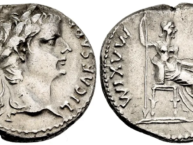
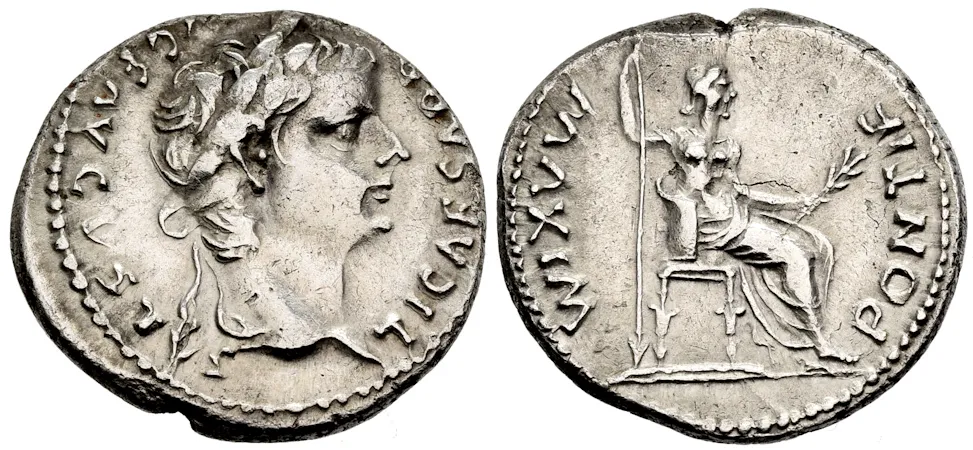
But Jesus didn’t come down with yesterday’s rain. He knew what they were up to, and instead of just answering them, he tells them to produce a coin used to pay the tax – a denarius. The coin was minted with the image of Caesar. On the denarius at that time, the image would have been of Tiberius, and the Latin inscription would have read “Tiberius Caesar, son of the divine Augustus.” On the back would be inscribed “PONTIF MAXIM or “High Priest.” He claims to be a son of God, the High Priest – it is blasphemous from a Jewish point of view, and why it was forbidden to use it in the temples (hence the need for money changers to exchange Roman coinage for temple coinage).
Back to the story, Jesus, looking at this coin asks them whose image is on it. When they respond that it is the emperor’s, he tells them, “Give therefore to the emperor the things that are the emperor’s, and to God the things that are God’s.”
And they stood in awe at what he had done by his response.
“Give therefore to the emperor the things that are the emperor’s, and to God the things that are God’s.”
Clearly Jesus isn’t condemning money, or even tax paying.
So, what then should we make of his answer? What did those who were testing him hear that set them back on their heels?
We need to understand it as much as they did, because we too face similar choices being presented to us today as those that the Pharisees & Herodians brought to Jesus.
Our government, today’s empire if you will, is using our tax dollars to round up, beat, or kill people without due process of law, destroy national parkland, pollute the environment, oppress and marginalize, engage in acts of terrorism or financial economic warfare against other countries, and so much more.
We don’t have to look far to see this play out. Earlier this month, in nearby Harrison NJ, a man was grabbed by federal agents, while his crying children, who were clinging desperately to him, were shoved aside. Some of those agents violated state law by being masked. Who is acting illegally in this case?
And just last week, in The Bronx, a federal agent came up to the car of Oscar Belgal and began banging on the windows to break the glass, while his 5 year old child was in the backseat! Oscar attempted to evade the officer, and what ensued was horrific. Agents shot into the car multiple times, severely wounding Mr. Belgal in the neck and endangering his young son. Who was acting legally here? That child, by the way, has not been able to speak since witnessing the horror that happened that day.
This is when some say, “They are here illegally,” to justify our government murdering people in the streets, throwing them into small cages, or taking away their little children. These are the Pharisees and Herodians of today who lean on the first part of Jesus’s answer: “Give therefore to the emperor the things that are the emperor’s…”
Oh, where to start…
How about with this: More than 70% of those arrested, deported, abused, or killed by ICE & Homeland Security have no criminal record. Even if they did, they would be entitled, under the 5th and 14th amendments, to due process – their day in court – to defend themselves. So, if we want to talk about what is legal and what is not, let’s start with this: It is not legal for our government to engage in immigration enforcement as we have seen done by this administration, and the courts have been making that point very clear. Adherence to the law has to go both ways – to the government as well as the governed.
Sadly, our government is not interested in what is legal when it comes to protecting the rights of anyone who isn’t white, straight, male, or Christian. That is the corruption of being guided only by the laws of empire, and not the laws of God – you end up violating both.
And let us also remind those misguided Christians, that while Jesus was telling us to follow the law of the government, “to “Give therefore to the emperor the things that are the emperor’s” he didn’t stop there. He said also, “…and to God the things that are God’s.” Something they seem to have either forgotten, or think it only means tithing to the church.
So, let me be clear: Jesus is saying that, while it is true we are citizens of an empire, we belong first and foremost to God, which comes with a different set of responsibilities. And second, the currency of the empire is not the currency of God.
Rome’s currency, like that of many governments, including ours, has images of government leaders – either dead or current. It is a reminder that we are the ruled, not the ruler. To be fair, taxes themselves are not always bad either. They can be used for good as well too – things like education, healthcare, public safety, environmental protection, and more. So, it is our legal obligation of our civil life to provide for the common good, which taxes are supposed to do – even if they are sometimes misused. And government issued currency is also used for more than just paying taxes. We use it for trade, wages, necessities, and if fortunate enough – entertainment and leisure activities. And of course, we use it to support the mission and ministry of the church by our tithing, which is a very good thing.
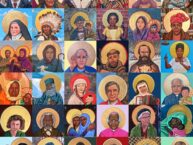
The currency of God, on the other hand, is not minted with gold, silver, copper, or specially coded paper. It does, however, bear an image – ours. The image of God is minted on the face of all people – no matter where they were born, what language they speak, who they love, what gender they claim, or how they pray. We are created in the image of God, and we are God’s currency in the world.
And how we spend our time and our gifts – spiritual or financial – is very different than how a tax works.
Taxes are a legal obligation.
Our lives and how we live them – that is a moral choice we make.
“Give to God the things that are God’s.”
Whatever gifts we have must be spent in the building up of God’s kingdom – speaking for those without a voice, caring for those in need, freeing the oppressed, and nourishing the creation entrusted to us.
For those of us baptized into Christ, this is our calling, and one we take on with joy – something most of do not feel about taxes. I mean, I don’t know about you, but I certainly don’t feel all warm and fuzzy inside when I fill out all those forms and send a check to the IRS.
We should always seek to follow the law, but we should never allow that law to bind us from our lives in Christ, because legality is not the currency we trade in as followers of Jesus. And to be sure, there will be times in our lives when what is just is at odds with justice itself – when the law of empire is in conflict with that of God. For we know, as followers of Jesus that what is legal is not necessarily what is moral, just, or good.
The crucifixion of Jesus was legal, but it certainly was not moral, just, or good.
Slavery & segregation in this country was at one time legal, but it certainly was not moral, just, or good.
Up until 2005 in the US, when the last state enacted laws against it, men could legally rape their wives, but that didn’t make it moral, just, or good (and yeah – it was not that long ago folks).
Immigration law and border protection is not without need of improvement, and certainly within the bounds of our government’s role, but brutality, cruelty, racist selective enforcement, and murder are not legal, and are against the higher law of God.
Legality and morality, the justice system and justice – they are not always one and the same. What we owe to our common society – to obey the laws – is not the same as what we owe to God. The coinage of God, in which we are to deal, is mercy, love, justice, and righteousness.
So clearly, there are times when what we are to give to God will be in tension with the ones demanding our homage to our current empires. That is when we may be called to risk our freedom and our very lives for that larger calling. Jesus knew that. The Rev. Dr. Martin Luther King, Jr., Sister Dorothy Stang, Jonathan Daniels, the Nuns of El Salvador, Archbishop Oscar Romero, and so many more martyrs in the cause of human freedom and dignity knew that too.
Guided by their calling, their deep faith in Christ, they gave to God what was God’s and challenged the tyranny of power that sought to oppress. By their faith and courage to live it fully, they paid the ultimate price.
Most of us, thankfully, will never face that choice, but all of us are still called to choose how we spend the currency we are given by God. And we must always place that currency we owe to God – the moral one, above all else. For while violating one may land you in prison, violating the other will condemn you for eternity.
And so we must ask ourselves – if we are stamped with the image of God – how must we spend our lives? What is God calling us to do or to say in these troubling times?
The answer to that will be found in those quiet moments of prayer beneath the trees, in the nourishment of the Eucharist shared here, in the unguarded moments of our day when that still small voice of God can be discerned.
These are the small moments of personal sabbatical that prepare us, so that when we find ourselves at the crossroads of justice – when we, the ones minted with the image of God, are faced with a choice we never hoped to have to make – between what is “legal” and what is moral, just, and good, we will, by the grace of God, know what we must do.
And we will joyfully give to God what is truly God’s for the sake of the world, and of our very souls.
Amen.
For the audio, click below, or subscribe to our iTunes Sermon Podcast by clicking here (also available on Audible):
The Rev. Diana L. Wilcox
Christ Church in Bloomfield & Glen Ridge
October 18, 2026
Twenty Fourth Sunday After Pentecost
1st Reading – Exodus 33:12-23
2nd Reading – 1 Thessalonians 1:1-10
Gospel – Matthew 22:15-22