 May 31, 2026 – Trinity Sunday – May God’s words be spoken, may God’s words be heard. Amen.
Good morning, and welcome to Trinity Sunday, when priests usually pass off the sermon to unsuspecting seminarians or assisting clergy. Kidding. Sort of. This is one of the Church’s principal feast days, and the only one that celebrates a doctrine, rather than an event or a person. The doctrine itself is the work of the earliest Christian theologians, who were trying to find a way to understand the nature of God, Christ, and Holy Spirit. Each being part of our scriptures, but their relationship to one another was not in our sacred texts. The Trinity, as a construct, came later. And this mystery of 3 in 1 and 1 in 3 can often end up leading even well intentioned people of faith down a theological rabbit hole.
So, that’s why I am not going to preach about it, other than to say this: The doctrine of the Trinity is not a complete description of God, because that is impossible. The doctrine of the Trinity is a way of describing relationship – the relationship of God, Christ, and Holy Spirit – yes. But, it is also a way to understand ourselves – the ones made in God’s image. “The Trinity is a statement of how God relates, not how God is. Or perhaps how anyone relates is indeed how one is.”[1] And when it comes to God, the relationship – God, Christ, Spirit, and us, is an eternal and unconditional dance of love.
And if there is one thing we all need now is an eternal and unconditional relationship of love – God’s love for us, our love for God, and loving our neighbor. So, with all that in mind, let’s look at the passage from Genesis that we heard today, because there is a lot there that will feed us as we move along in these difficult days.
Now, there are two creation stories in the bible – three if one were to count the Revelation to John as a creation story of sorts. Many, if asked how humanity was created, would say Adam from clay and Eve from Adam’s rib. But that is found in the second chapter of Genesis, not the story we get here – the one given primacy in the scriptures.
Why two? Well, why four gospels? On Genesis, scholars believe they came from two different cultural traditions and were kept together so as not to lose either. The differences are more than just the introduction of humanity, and a full description of them is really too much to get into today, but suffice it to say that Genesis 1 offers a cosmic God, and Genesis 2 a personal one. Genesis 1 moves from dark chaos to order to sabbath. Genesis 2 from dry land to water everywhere. Which is right? A rabbi of these Jewish texts would say “they both are.” Which is why these are not meant to be read literally, but faithfully.
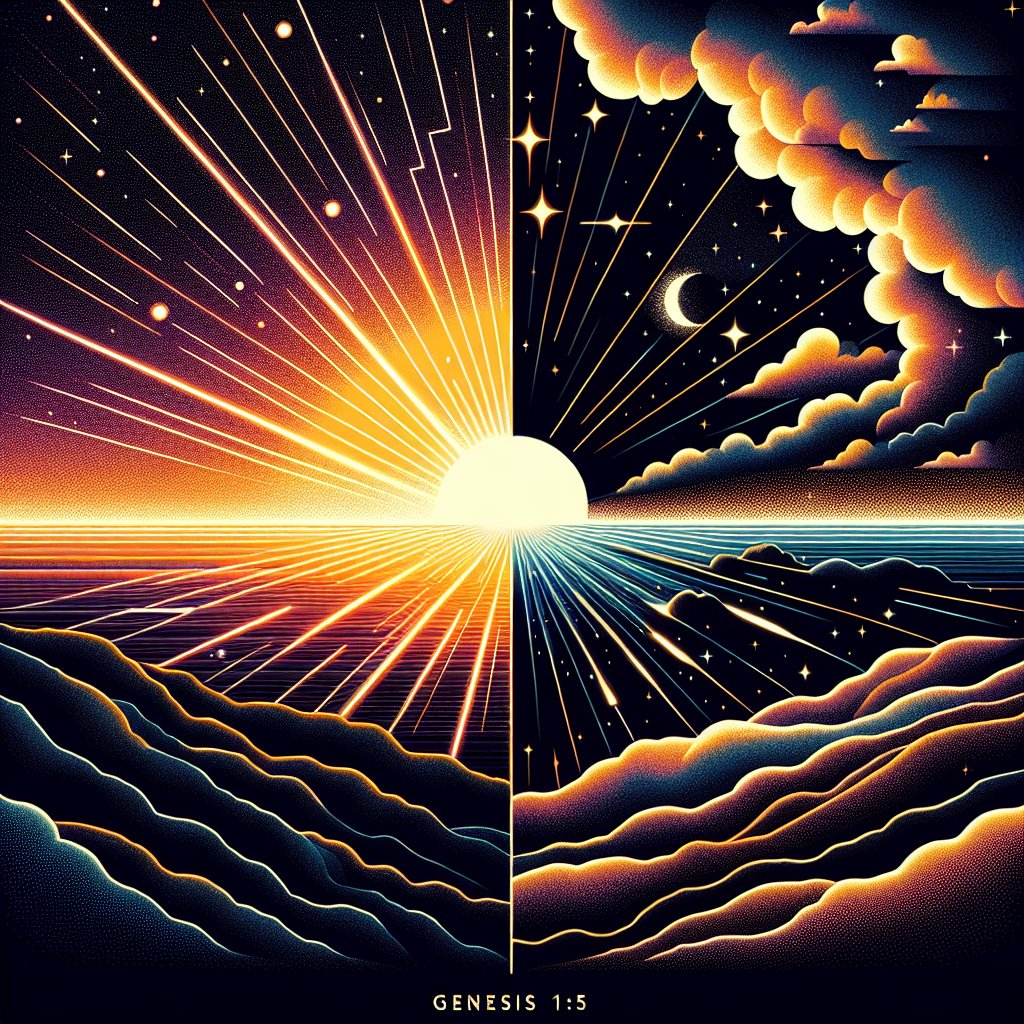
The story we hear in those first 35 verses of our bible begins this way (using the NRSVU translation): “When God began to create the heavens and the earth, the earth was complete chaos, and darkness covered the face of the deep, while a wind from God swept over the face of the waters. Then God said, “Let there be light,” and there was light. And God saw that the light was good, and God separated the light from the darkness. God called the light Day, and the darkness [God]called Night. And there was evening and there was morning, the first day.”
It goes on like this, each day God creating something – heavens & earth, sun, moon, and stars, coffee and fast food, etc. And then there was the 6th day when God created all the animals of the air, the sea, and those that dwell on the earth, and also humans! Yup, that’s right, we were created on the same day as all the other animals. That was a very long 6th day to be sure for God. Oh, and the text also says that both humans and animals were meant to be vegetarians. Missed that part? Well, it’s right here: “God said, “See, I have given you every plant yielding seed that is upon the face of all the earth and every tree with seed in its fruit; you shall have them for food. And to every beast of the earth and to every bird of the air and to everything that creeps on the earth, everything that has the breath of life, I have given every green plant for food.” I suspect nobody asked the plant life how it felt about all that.
I once pointed that out to a friend from Texas who loves her BBQ and she was like “WHAAAATTTT???? NO!” Don’t worry though, that all went by the scriptural wayside later.
Anyway, then God declared all that was made on that 6th day good. God didn’t say “Love those animals we created, but the humans – well, they are just awesome!” Nope. Just the same divine thumbs up at the end of a long day for all of it. That outta humble us a bit.
And, as we point out in the diocesan Anti-Sexism training, God said “Let us make humankind in our image – male and female.” Of course – there is that bit about God saying “Let us” and “our,” making it clear that God is the ultimate non-binary being. But something the church and the world so frequently ignores is that the image of God is equally in women as in men.
So – lots to consider in this one creation story. Of course, as noted earlier, we should read this passage, and our entire bible, not literally, but with a focus on the context in which it was written, and draw from all of it the meaning God has for us – the truth found within and between the lines of text. With that in mind, let’s think about what it is telling us today. Why do we need to hear it now?
You know, with all the cold and rain we have had coming into the past week, it has sort of felt like we might never know the warmth of sunlight again. Some of you feel, or know people who do, this type of darkness from the grief, pain, or fear you face personally. And of course, for all of us, there is also the darkness of the world that we feel and see and hear all around us.
We all know about the violence of war in Iran and Ukraine and other places. We know too about the violence in our schools, places of worship, and in the streets. We know the violence of government agents against citizens and non-citizens alike, and those who protest on their behalf. But most of us will never know what it is like to be tossed into one of these concentration camps our government runs.
Specifically, reports out of Delaney Hall in Newark, just a few miles from this parish, describe what these inmates are living through there – rotted or infested food, unsanitary conditions, pregnancy, cancer, and other medical conditions left untreated, and physical beatings. In some prisons across our country with similar conditions, suicides are on the rise. In a recent study, it was found that 73% of those imprisoned by ICE and CBP have committed no crime, and even if they did, we believe in this country that people should be treated humanely. And,100% of those picked up by ICE & CBP have not received due process of law that is owed to every single person – citizen or not – within the borders of our country by the 5th and 14th amendments of our Constitution.
The horrible conditions have led some in Delaney Hall to go on a hunger strike. Protestors, including faith leaders, have been supporting their families outside and speaking on their behalf. Government leaders have tried to gain their rightful access to the facility to inspect it and speak to the prisoners, and they most were not only denied, but in some cases they have been pushed, pepper sprayed, or arrested.
What is happening in our country now has created a chaos as dark as an abyss. And so, as I stood in protest with other faith leaders at Delaney Hall this past Friday, looking into the eyes of Federal agents, or gazing up at the prison windows, I thought about this text – and there I found hope.
Remember – darkness and chaos covered the earth, the Holy Spirit – the breath of God – moved over the waters. And into this, God decided to first create light. Was it to see everything better as God continued to create? I doubt that. The thing is, scientists know that light plays an important role in sustaining life. And we all know, that light, even the hope of it, can sustain us in times of deep darkness – the thought of it can keep us going, even when we are unable to see it.
We hear that in the iconic poem found scratched into the wall of a cellar where Jews were hidden in Cologne, Germany, which read:
“I believe in the sun even when it is not shining.
I believe in love even when I do not feel it.
I believe in God even when God is silent.”
Imagine the darkness that surrounded the person who etched that into the stone – fear, violence, hatred of others, war, loss of loved ones. The sun was not shining into that cellar, but its promise was a lifeline of hope in a time when love could not be felt. And it was that knowledge, deep within whomever wrote it, that is a sign that God was not silent at all, but present in that very place in that very moment, with one who felt so alone, so afraid, so unloved.
This is why God chose to make light the first act of creation – because God knew that without light, with darkness ever present, life would quickly wither into nothingness.
So, if all of that is true, why then did God not make everything full of light? I mean, even with the understanding that these stories were not meant to be taken literally, this version does beg the question – why did God keep the darkness alongside the light, and called it all good!
Maybe part of the answer is found in what God did on the 4th day – creating the stuff in the sky we see at night – the stars and the moon. A reminder that darkness is never fully in control.
Perhaps it is also so that we can better understand the nature of light itself, and what that gives to us. If you light a candle, or flip on a switch, in a dark room, the light enters, and the darkness instantly vanishes. They cannot coexist in the same space; light always wins by displacement. In a one to one matchup – light always overcomes darkness. Every.Single.Time.
But maybe the biggest reason of all is because God is at work in the darkness too. Remember, God wasn’t absent in the void before the light – God’s breathe – the Holy Spirit – moved across the deep. Think about a photographer’s darkroom. For the photos to be properly developed, only a safe light – not visible to the film – can be present. The darkroom isn’t a place of destruction or absence of the good. It is a place of creativity and development. The newly created work will emerge into the light when it is ready.
In the same way, God is not absent in the darkness of our lives. God is at work then too, doing perhaps the deepest development work in our lives at that very time when we feel so lost, alone, afraid, or abandoned.
And like the way we feel when we gaze upon the stars and the moon on a clear night, or a campfire in the evening, the mixture of light and dark can inspire and even entrance us. Just last night many of us experienced a transcendent moment in this very church as we sat in darkness, surrounded by hundreds of candles while a string trio beautifully played the music of Coldplay. It was amazing and inspiring..
The thing is – God knew that the chaos that existed before would always be – would always linger. The humanity God would create would encounter darkness – some of its own making, some of the world. That is why God didn’t eliminate the darkness, because God was at work there too. God then created light, that we would know that darkness doesn’t have the last word – the dawn always comes, the sun shines after the storm, and darkness is unable to exist in the presence of light.
That is also why the light of God – Christ – came into the world.
To breathe life into our very souls that we may transcend the chaos swirling around us.
To show us that even hate and violence wrought down by the powerful like the Roman Empire cannot defeat God’s love.
To show us the power of light – his light – to overcome even the most insidious darkness.
And as followers of Christ, we are the children of light.
We are a part of that never ending act of creation whenever we love and serve in his name.
Whenever we speak for the voiceless.
Whenever we stand against injustice.
Whenever we love unconditionally those others have cast aside.
We bring light into the shadows, and the darkness will never overcome us, for it can never withstand light – the light of God’s love and grace most of all.
And at the end of our own six days of creative action in the world in partnership with God, we will also take our sabbath rest – right here at this table, and in this community. Here we will receive respite from our labors, and strength to meet the journey ahead in the nourishment of Christ’s great love.
And finally, at the end of all our days, at the end of our witness of light in the abyss of humanity’s evil, we will take our final sabbath rest in the communion of Saints.
And God will look at all that we have done, and declare it very good.
Amen.
For the audio, click below, or subscribe to our iTunes Sermon Podcast by clicking here (also available on Audible):
[1] Bob Eldan. http://preachingtip.com/archives-year-b/pentecost-year-b/trinity-sunday-year-b/
The Rev. Diana L. Wilcox
Christ Church in Bloomfield & Glen Ridge
May 31, 2026
Trinity Sunday
1st Reading – Genesis 1:1-2:4a
2nd Reading – 2 Corinthians 13:11-13
Gospel – Matthew 28:16-20