 May 10, 2026: May God’s words be spoken, may God’s words be heard. Amen.
Happy Mother’s Day, and many good wishes to those celebrating. It is a joyous occasion for most – offering a time to appreciate the love of their moms with maybe flowers, a visit or a call, or some other way to thank them. For others, this is also a difficult day, or one that brings about mixed feelings at least. For they are those whose mother’s have died, or those whose mothers are absent – in whatever way that may mean – or those mothers who have lost a child, or those women who could not have one. For these people Mother’s Day can be troubling, awkward, or even painful. And if that is you, know that we, your parish family, are holding you in prayer.
And so, as I say each year, that is that is why I like to think of today as less about Mothers specifically, and more about women – mothers, sisters, daughters, wives, nieces, aunts, and friends. Women who have been a part of our lives – nurturing, mentoring, loving, caring. That is what we really celebrate today – the journey of women – us, if we are women, and those women who have been a part of our lives.
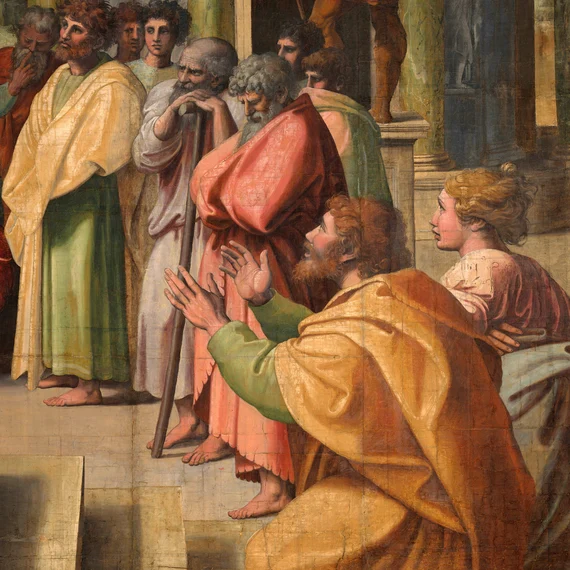
And there was a woman listening to St. Paul in the passage we heard today from the Acts of the Apostles, but you wouldn’t know it based on the reading for this morning. As the story we heard goes, St. Paul was speaking before the Areopagus. What we didn’t hear was why.
See, while he was waiting for his preaching buds Silas and Tim to arrive in Athens (why is a whole other story), Paul had been walking around town seeing among the bustling city lots of monuments to various Gods, even an altar that, as he would later note, was inscribed with this: “to an unknown God.”
As Paul does, he taught people in the synagogues and the streets about Jesus. Now, this is where the previous verses get funny, and why I think they should be included. It goes like this: “…some Epicurean and Stoic philosophers debated with him. Some said, “What does this pretentious babbler want to say?” Others said, “He seems to be a proclaimer of foreign divinities.” … So they took him and brought him to the Areopagus and asked him, “May we know what this new teaching is that you are presenting? It sounds rather strange to us, so we would like to know what it means.” Now all the Athenians and the foreigners living there would spend their time in nothing but telling or hearing something new.” That is part of what is missing from the story. The part we did hear was this…
St. Paul then speaks before the council, mentions the bit about the “unknown God,” and in classic Paul style, uses their own poetry to counter the notion of such a thing. He quotes Aratus (a Cilician poet) in the phrase “For we also are his offspring,” and likely refers to Epimenides of Crete with the phrase “For in him we live and move and have our being” to counter the idea that any God would be unknown to their own creation. Socrates would have been proud of his use of their own words, and given that Paul was university educated, with excellence in rhetoric and debate which we see in his writings, it also isn’t surprising.
Then Paul told them about Jesus – about his life, death, and resurrection. For reasons that confound me, that is where the lectionary stops this reading.
But on this day, when we celebrate the women in our lives, we need to hear, as the late Paul Harvey would say, “the rest of the story.” The text continues with this: “When they heard of the resurrection of the dead, some scoffed, but others said, “We will hear you again about this.” At that point Paul left them. But some of them joined him and became believers, including Dionysius the Areopagite and a woman named Damaris and others with them.”
Now, there are are a few things to note about Damaris, especially on a day when we celebrate women. First, that she is mentioned at all by the author. In his book Jesus and the Eyewitnesses: The Gospels as Eyewitness Testimony, New Testament scholar Richard Bauckham argues that named individuals in the Gospels and Acts are not random, but rather were known to the early Christian communities as key witnesses, leaders, or teachers. This would be especially true of any women named.
Second, some try to link Damaris by marriage to Dionysius, the other convert mentioned in this story. Nowhere does it say that, and the author of Luke-Acts, being a stickler as he was, would have done so if it had been the case.
And third, is that she is standing there listening to St. Paul speak before the Areopagus in the first place. The Areopagus was a place for centuries where the learned, the most respected in that region, the most powerful, would listen to and debate ideas, pronounce judgements over serious criminal matters, and wrestle with larger questions of science, philosophy, & religion. Damaris would have had to have been wealthy, intellectually gifted, powerful, or all of the above.
So, there is a lot for us in this larger story about St. Paul, a bunch of Greek philosophers and judges, and Dionysius and Damaris. And we need to hear it too, especially amidst all that is happening in the world today. For starters, there the inscription on the altar that Paul saw and spoke about.
One wonders who constructed it, and why? As I was thinking about that, I was struck by this one part of the Psalm we heard today. The Psalmist speaks of God as one, “Who holds our souls in life.” Think of that for a moment. What does it mean that God is one that “holds your soul in life?” There is such a sense of care, of nurturing, of love in that imagery – and most of all – of knowing. That God knows us.
The thing is, we hear this not only in that Psalm, but throughout the scriptures of our faith. We hear that same message, or something like it – over and over and over again in many different ways. From Genesis 1 to the final chapter of the Revelation to John, our scriptures remind us that, as those Greek poets Paul quoted made clear – God created us, and in God we have our very being – God holds our soul in life with great love. This is why at the Easter Vigil and in Lessons & Carols we get texts that span the entire bible – to tell the story of God’s relationship with us through time as a reminder that our God didn’t begin loving us when Jesus was born, but he was born to us because God has loved us from the beginning of time. That God does indeed hold our souls in life…or really, in love. And that type of relationship, the one God has with all of creation, rooted in unconditional love – means that God knows us – knows us deeply – even if God is unknown to us.
All of which brings me back to whoever built that altar. The thing is – it wasn’t built because they thought God doesn’t exist. Why bother? No, it was built because they could sense God’s presence – could sense that there was something larger than themselves – they just didn’t know how to name what they were feeling. This was a seeker – something we all have been, and hopefully still are, or we wouldn’t be here right now.
We don’t stop seeking just because we walk in the doors of a church and sit in the pew. Or I sure hope not. It is practically in the DNA of the Episcopal Church to seek, to question, to wrestle with what we think we know. And seeking is as much about what is sought as it is about the one who is searching. The spiritual seeker wants to understand the Creative force they can sense in the world, but learns as much about themselves when they do. Understanding is about knowing – about seeing and being seen. And the truth is that we not only seek God that we may know God, but also that we may feel seen and known ourselves.
So many people in the world today yearn to be seen – not looked past, ignored, or pushed aside. They want to be listened to, not because they think they have all the answers, but because in listening, we see them a bit more.
That is why it is so important to lift up Damaris in this story. So many women in scripture get ignored or go unnamed – and even our lectionary cuts them out. But the patriarchy rooted in sexism isn’t just a part of faith traditions like ours. Women all across time have been left out of our history books – their inventions, courageous acts, writings, or leadership unacknowledged – their names unknown.
If we are to ever know God the way God yearns to be known, we cannot ignore or abuse what God creates, especially those made in God’s image – the women as well as the men. For when we do, when we ignore and abuse the very soul God holds in life – we willingly do the same to God.
Which brings me back to Damaris. She was noted by the author of Luke-Acts, and we should not make the mistake so many do and take no notice of her. We will remember Damaris today. We will say her name and tell her story.
But there is something else going on in this story – something missing from our world today (not to mention the lectionary). Paul was doing as evangelists are meant to do – all of us really – he was talking about his faith. That’s a good thing! Yet, the lesson we most need now though does not come from Paul. It comes from the Athenians, and begins in the part left out from the passage, which I mentioned earlier.
Sure, some thought he was a “pretentious babbler,” which, if you read a lot of Paul’s writings you might agree with them. And yet, they didn’t throw stuff at him, push him aside, or arrest him for saying things they didn’t like or understand (as we know happened to Paul in other places). What did they do?
Well, this is why this earlier part is so important, and why I cannot figure out why it was left out – I mean, how can you understand the full scripture of you don’t hear it? Just a reminder, this is how they responded: They said to Paul “May we know what this new teaching is that you are presenting? It sounds rather strange to us, so we would like to know what it means.” The text goes on to describe all of the people in that region, saying “Now all the Athenians and the foreigners living there would spend their time in nothing but telling or hearing something new.”
And when they listened more to Paul in his speech before the Areopagus, they didn’t throw him over a cliff for speaking about something they hadn’t heard before – nor did most of them immediately accept what he said. In the final part of this story, again left out of the lectionary for today, they said instead “We will hear you again about this.”
We should not be surprised by their response. Anyone who had to read Plato in school knows Socratic dialog, which originated in Ancient Greece long before Paul or Jesus were born. For that matter, anyone who reads some of the epistles of St. Paul see in them this method of question and answer to get to truth. Some scholars have pointed to striking similarities between Socrates in Athens and Paul in Athens – something the learned author of Luke-Acts may have been trying to bring to mind.
But while interesting, especially if you enjoy trips down the philosophical rabbit hole, the most important part is in the invitation to dialog in the first place offered by the Athenians in the face of something they either did not know, or did not believe to be true. If only we today would do as these Athenians and the others in Athens at the time of Paul’s travels are doing in this story.
Instead, most people would just change the channel, walk away, yell and scream, or Gerry-mander them into silence. If you are in our government, you would arrest and indict them, or push to have them taken off the air. What would the world, or really – let’s narrow that down…what might our country be like if we were to listen more to what we don’t understand, invite those who offer different opinions to speak to us, or at the end of a contentious town hall say “We will hear you again about this.”
If we think about it – listening is one of the ways we see others, one of the ways we say to them that they are known to us. One of the ways we become known to them too. And seeing someone, getting to know them a bit, is the first step toward loving them as we are called to do. It is also the first step toward knowing God.
So as we leave here and head out into our own public squares – divided as they are – let us question as the Athenians what we hear from others, not to shut down, but so that we can better understand, see, and know – them, the truth, and the God who created it all.
And let us hear of the resurrection of Christ and have our hearts moved in such a way as we become like Damaris – leaving this place to proclaim the good news in such a way that we cannot be pushed aside and be forgotten or ignored. For there are far too many yet for whom God is still unknown, who yearn to be known themselves, who dream of being seen and loved by One who would hold their soul in life.
Amen.
For the audio, click below, or subscribe to our iTunes Sermon Podcast by clicking here (also available on Audible):
The Rev. Diana L. Wilcox
Christ Church in Bloomfield & Glen Ridge
May 10, 2026
The Sixth Sunday of Easter
1st Reading – Acts 17:22-31
2nd Reading – 1 Peter 3:13-22
Gospel – John 14:15-21