 March 1, 2026: May God’s words be spoken, may God’s words be heard. Amen.
It would seem we are once again at war. Yesterday, our country again attacked another country without provocation. In this attack, we teamed with another nation already accused of war crimes. This unconstitutional act, one of many by this President, has and will, kill and injure innocent people. We must all hang our heads in shame, but none more than our Congress, who sits by while this illegal power grab endangers us and other countries around the world. One can only wonder how things might have been had the President not torn apart the 2015 treaty with Iran on nuclear disarmament?
And all of it, all this carnage, likely has been done to distract us from what was found to have been removed from the release of the Epstein files. How many more people will have to die to save the face of powerful white men?
These are questions for all of us to ask at this time. And to be sure, questions are important. They are the beginning of knowledge. The thing I love about The Episcopal Church is that we not only welcome questions, we ask a lot of them ourselves. You know who else had questions? Nicodemus.
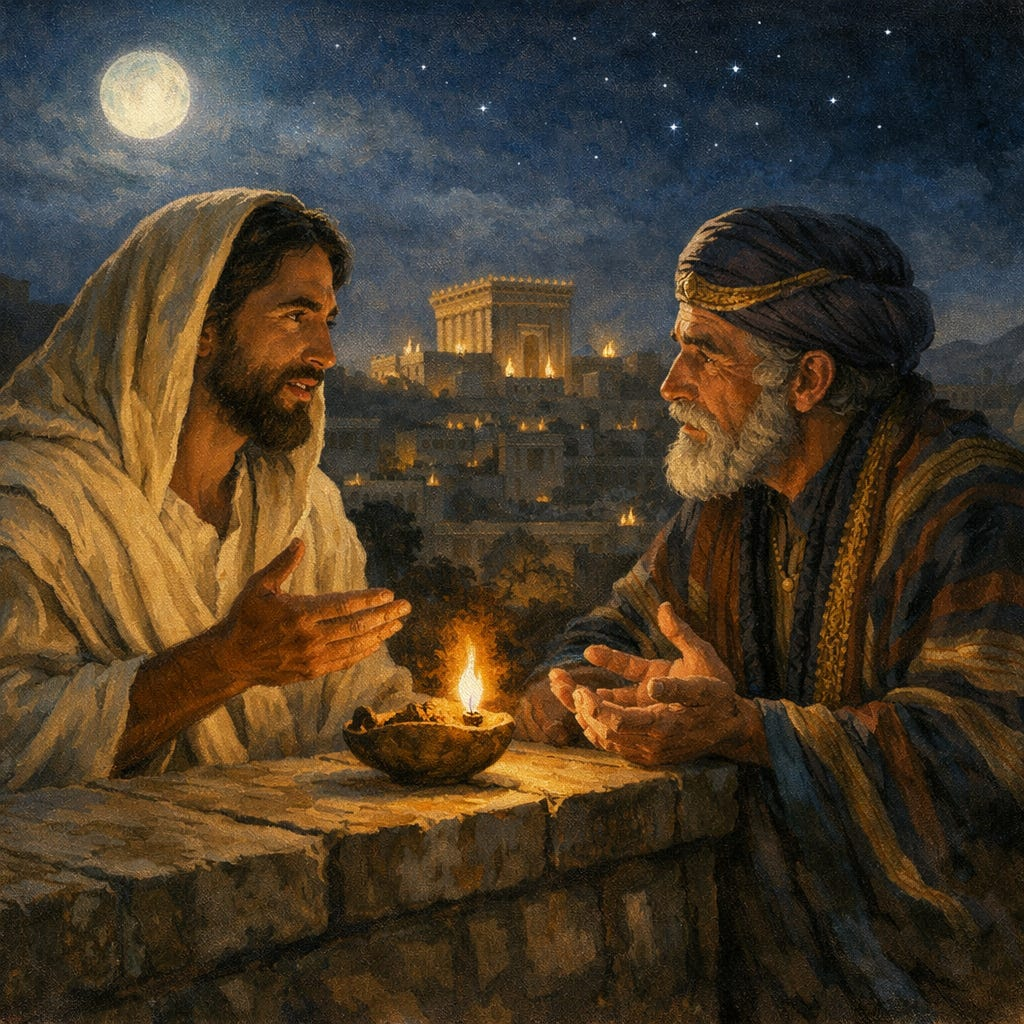
In the gospel today, we get the “Nick at Night” story – a favorite of mine for so many reasons. The story itself is often forgotten though, and only the final verses remembered. In fact, John 3:16 has reached meme and social media trope status. That is a shame, because the fuller story is much richer than that, and too many have used that one verse for purposes antithetical to who Jesus and Nick were, and what our savior taught. So, let’s take a closer look.
Nicodemus has heard a lot about Jesus, and he goes to see him. Now, about our guy Nick – he is a member of the Sanhedrin. We hear about the Sanhedrin in the trial of Jesus, but there are varying accounts of who they were and what their purpose was in that period. Suffice it to say that the common ground is they were the elders of the Jewish faith who were basically a religious and political council or court – in other words, they were leaders among the Jewish faithful, which makes our guy Nick a powerful man. But, back to our story…
In true Gospel of John fashion, we are told that Nick seeks out Jesus at night. Now, in this last to be written gospel, light and dark are used not solely as time of day descriptors, but as symbols of knowing and unknowing, good and evil, and so on. So, Nick walks in the darkness of unknowing to seek the light of knowledge found in Jesus. And Jesus welcomes him.
And the first thing that happens is Nick says “Rabbi, we know that you are a teacher who has come from God; for no one can do these signs that you do apart from the presence of God.” Good start, right? Always butter up the teacher. Here’s what happened next (I’ll paraphrase, you know, as I do):
Then Jesus answered him, “Look Nick, I’m glad you came seeking the truth, but I tell you, no one can see the kingdom of God without being born from above.” Nick replied “What are you talking about? Nobody can do that…what, crawl back into the womb? That’s crazy” Jesus, thinking this might take longer than he thought, pours a cup of coffee for them both, sits back down and says “Think outside the box Nick, you know. You must be born of water and Spirit. When we are born from the womb, we begin our human life. When we are born of the Spirit, we begin our spiritual life.” Seeing a puzzled look from Nick, Jesus tries again. “Think of it this way, the wind blows where it chooses, and you hear the sound of it, but you do not know where it comes from or where it goes, right? So, it is with everyone who is born of the Spirit.” Nick replied, “How can these things be?” Jesus, doing a face palm, answered him, “You’re a Rabbi yourself, do you not understand what I am getting at?”
Now, I think Jesus does a face palm today too, every time somebody reduces this part of the passage down to a slogan, claiming they are “born again, ” or asking if you are too. Don’t get me wrong – we do it too, in our baptismal liturgy – but for a different reason and with a different meaning. But let’s be honest here – when we hear “born again,” what usually comes to mind is that type of Christianity in which pure belief is marked by dogged literal interpretation of scripture and a fundamentalist world view, where questioners like Nick are not particularly welcome. Folks, that is NOT what this is about, and it would have been antithetical to how Jesus taught and how scripture and faith were understood in his time, not to mention getting the Greek of this passage wrong – it is born from above, not born again. Questions and debate about scripture were a part of the Jewish and Christian traditions for centuries. Literalism and dogmatic allegiance to it, were not a thing until its birth in this country around the 18th century.
Unfortunately, the issue with literalism, besides that they get the literal wrong in this case, is the link it has to a fundamentalist notion that if you REALLY believe – you won’t have any questions. Questions are scary…questions will shake the foundations of the faith they have built for themselves.
But Jesus…Jesus invited questions.
And so should we.
And what I love about our buddy Nick…he just kept asking them. He was a seeker – a person of deep faith not afraid to venture into the darkness of the unknown to encounter something that just might rock his world. Nick is a model of faith.
Now, I know, you might be thinking – but he didn’t understand…he still had questions. Yeah…and so do I, and I bet some of you do too. Look, faith isn’t living without questions – faith is living into the questions, until, as the poet Rilke once said, we live one day into the answers. And Nick did find the answers he sought, as described later in this same gospel.
But let’s get back to that other part of this gospel – the one that gets put across football stadiums, tattooed on arms, or croched into pillow cases. John 3:16. See, after the back and forth with Nick, Jesus then talks about the coming of the Son of Man (him) and what that means. He then says, “For God so loved the world that he gave his only Son, so that everyone who believes in him may not perish but may have eternal life.”
Lordy, if there is one verse that has been misunderstood more than this one, I am not sure I know what it is. Oh wait, yup – that one where Jesus says “No one comes to the Father, except through me,” also in this gospel. Now, why would these both be in the Gospel of John. For that matter, what is with all the references to “the Jews” in it? I mean, were not Jesus and all his disciples Jewish? Good questions to ask. The answers are: Yes, they were all Jews, and the community that wrote this gospel (also Jewish) was having a bit of a split with the mainline Jewish communities of that period (which, so you know was decades after Jesus walked the earth). Think of it like the reformation, where Roman Catholicism and so-called Protestantism were both Christian, but didn’t like each other so much, and it showed in their writings. So, we are getting a bit of author’s post-breakup revenge in what we hear in this gospel, not a condemnation of Judaism itself.
The thing about the Gospel of John is that, while filled with beautiful metaphor, poetry, and Christology, it’s harsh language has been used to support horrific actions against Jews throughout the centuries. In fact, that is why Christian leaders today urge the larger church to modify the language from that gospel that we use on Good Friday, which we do here at Christ Church, because for centuries people would hear in those texts that the Jews killed Jesus, and use that as an excuse for killing Jews anywhere they could find them.
Now, to be sure, it isn’t the only Christian text that is problematic, but one question we all need to ask is – why do these scriptures become tools for hate so often? Why would we hear this verse of John 3:16 and think – God rejects anyone who isn’t a follower of Jesus and so should we? Oh, because it says that God gave Jesus to the world “…so that everyone who believes in him may not perish but may have eternal life.”? Well, what’s missing? Wait, could it be this part – God so loved the world? Yup. Indeed it is.
God so loved the WORLD!
The whole world!
And you know why that is?
Because God created all of the world, and because God is love. And you know who is included in that love – everyone. Sure, if you follow Jesus – loving one another as he commanded, loving God and neighbor as he taught – you will be saved. But so will everyone else who does the same. And truthfully, even not doing that won’t change God’s love.
Even when we fail. Even when we lose our way. Even when we try to reject God’s love and harm others – God loves us anyway. God’s love is unconditional and for all time. And it is for everyone.
God so loved the World!
The world that includes Iranians, Russians, Palestinians, and Ukrainians.
The world that includes all Americans – from Canadians to Argentineans, Brazilians to Peruvians, and sure – even those here in the US.
The world that includes straight and LGBTQ+ people.
The world that includes all races, cultures, faiths, and languages.
The world that includes all women and men.
And the world that, as difficult as it can be to embrace, also includes those who do horrific things and claim to be “born again” or wear crosses and tattoos of John 3:16 on their arms while they do it. Yes, even them.
God so loved the world – the WHOLE world!
And God still loves it – all of it – all of the world – the sea, the sky, the air, the land, and all those who dwell within it. God loves them and God loves you. No exceptions.
The challenge for us to emulate that love, because it won’t be easy. And to do that, we need to pay attention to what Jesus said in John 3:17 as much as we do to the other verse. Because that says, “Indeed, God did not send the Son into the world to condemn the world, but in order that the world might be saved through him.” Jesus did not come to condemn, but to save.
Folks, this gospel passage – the entire story of Nick and Jesus – can teach us a lot, but not if we boil it down to platitudes based on a single verse. Instead, we need to live it out – the whole of it.
In these difficult days when our nation’s leaders are brutally persecuting or killing our neighbors in our streets, or bombing them in boats or on their native lands, we need to be like our friend Nick here in the gospel. We need to seek the light in the darkness. We need to ask difficult questions. We need to search for the truth (and not help to spread misinformation which only increases the darkness for everyone).
And then, like Nick, we need to go back into the darkness – carrying that light within us, that we may save the world God loves so much just as Jesus did, humbly and with courage. And, if Jesus wasn’t sent to condemn, then neither should we. Instead, as he did, we must save the world through love. That is why God became incarnate in Jesus – to model that, because it will not only save others, it will save us too.
And that is what I held in my heart this past Wednesday as I prayed and marched alongside thousands of other clergy in our nation’s capitol. We were there to make it  clear that God loves everyone – no exceptions. That love does no harm to a neighbor, and that includes immigrants & refugees, no matter their legal status. We took that love into the halls of congress where we met with congressional leaders and their staff – imploring them to stand by the values of their country, and if they have one, their faith. I spoke with Senator Booker’s staff about the proposed concentration camp in Roxbury, and asked that the Senator continue to do all he can to stop it, because each of the men, women, and children so inhumanely treated in these facilities is Christ himself.
All of us did this – prayed, marched, and lobbied – because we believe that God does indeed love the world – the whole world, and we will not sit idly by while empire once again tries to imprison and crucify Jesus – over and over and over again in our names.
Folks, these are dark times, and there are days when we will not even know what questions to ask, much less understand the answers all the time. And the answer we get one day, might just lead us to more questions the next – in fact, that is almost always the case. The thing is though, Christianity isn’t about easy answers, but about difficult questions. It isn’t about slogans, but about seeking.
And if we are to be a people Jesus calls us to be – we must ask the tough questions.
We must seek the light in the darkness.
We must love the world, not condemn it.
If we do that, we and all of the world God loves so much, will truly be saved.
Amen.
For the audio, click below, or subscribe to our iTunes Sermon Podcast by clicking here (also available on Audible):
The Rev. Diana L. Wilcox
Christ Church in Bloomfield & Glen Ridge
March 1, 2026
Lent 2
1st Reading – Genesis 12:1-4a
2nd Reading – Romans 4:1-5, 13-17
Gospel – John 3:1-17