 February 1, 2026: May God’s words be spoken, may God’s words be heard. Amen.
Tomorrow there’s this pesky groundhog that is supposed to tell us how much winter we have left, and I swear, if that rodent sees his shadow I’m gonna go have a word with him, and it won’t be pretty. This has been a rough winter – bitter cold, lots of snow, and darkness that is cutting us to the core.
But the groundhog isn’t the only thing that happens tomorrow. February 2nd is primarily, for catholics, Roman or Anglican anyway, the Feast of the Presentation, which is the final day of Christmas – for real this time – despite the stores telling you that Valentine’s Day goes from December 26th– February 14th.
Now, you may have noted that our gospel today is from Luke Chapter 2, and we are clearly still in the birth narrative, as Jesus is all of 40 days old. He isn’t even out of onesies or eating solid food yet. It’s a bit of whiplash, since he was just walking around as a 30 something calling his disciples in the gospel we heard the last time we were able to be here on January 18th. But as it is such an important moment in his life, the church marks it as a special feast day on February 2nd..
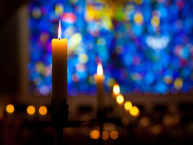
Now, the church expects us to only celebrate this feast on the actual day. But, because so many do not attend special weekday services, this day, like other feasts – of the Magi, for example – will get ignored if we do not celebrate them on a Sunday. So, as we did last year, today we will celebrate the Feast of the Presentation today. It is also a day on which candles are blessed for use at home and the church, so it is called Candlemas.
The scriptures of this moment feature so much in our daily lives for those of us who pray what is known in our church as the Daily Office. It also is part of our parish’s history, with two prominent stained glass windows associated with it – the center window of the Tiffany triptych in St. Mary’s chapel, and this one up there in the main tower. The chapel window shows the scene, and the tower windows have the words of Simeon, which we heard in the gospel reading. Now, let’s get to this story, because it is offers something important for us in the context in which we live now.
In the verse just before what we heard today, we find that Jesus is going to a bris, and  unfortunately for him, he isn’t the one bringing a gift. Joseph and Mary have him circumcised and he is named. Then we get to this story today, where 40 days after his birth, they bring Jesus to the temple to be presented to God in accordance with the law for her purification and his redemption that we get in that fabulous book that everyone loves – Leviticus. All this to say that Jesus is raised in the knowledge and adherence to Jewish scripture and law. There’s a lot going on in these verses, but I want to focus on two people – Simeon and Anna.
Now first we need to set the scene. The temple isn’t like the size of our churches today. This place is huge – many times larger than our largest cathedrals. So, you’d think no one would really pay any attention to this little family walking in. And yet, against all odds, two people did notice them – Simeon and Anna.
Simeon was, according to the text, a righteous and devout man who had been told by God that he would not die until he had seen the Messiah. He is guided by the Holy Spirit to come to the temple that day, and he listens and goes. There he sees the child Jesus, and takes him in his arms and says what is known in the church as the Nunc Dimmitis, Latin for the first words “now depart.”
I will use the version we say in Evening Prayer, which differs slightly from the wording we heard today: “Lord, you now have set your servant free to go in peace as you have promised; For these eyes of mine have seen the Savior, whom you have prepared for all the world to see: A Light to enlighten the nations, and the glory of your people Israel.” He then foretells to Mary the destiny that awaits this child, and that it will pierce her heart.
Then Anna, a prophet, sees the baby Jesus, and also proclaims the destiny that awaits him and what it will mean for the people of Israel. Of course, Simeon gets the focus in our prayer book, and Anna is essentially forgotten – what else is new, right?
So, what does all this have to say to us?
Well, let’s go back to our righteous guy Simeon. He says “…these eyes of mine have seen the Savior, whom you have prepared for all the world to see: A Light to enlighten the nations…”
To be sure, this is about far more than bringing light into the darkness – which, of course, is a powerfully important thing to do. But this is also about that light casting aside ignorance and bringing knowledge to the people – specifically, the knowledge of God.
Jesus would do both.
His presence among the people was the light that overcame the shadows of darkness, and he taught his followers what it meant to be part of the kingdom of God, rather than of humanity. He did this, not by sitting back in Galilee preaching in the synagogue, but by being out in the world healing the sick, advocating for the vulnerable, and spreading the good news of God’s love.
We are called to be like Jesus – a light to enlighten the nations. – in what we proclaim, and by our actions in the world.
And if there was ever a time to live out our lives in Christ, it is now, because darkness has spread across our country. People are being snatched out of their homes without a warrant, pushed to the ground and beaten, children are grabbed and sent to prison, protestors exercising their first amendment rights are sprayed intentionally up close with chemical irritants or bombed with tear gas, and others are brutally killed. This is a time when all the world hopes for a light to enlighten our nation! And folks, there are a LOT of followers of Jesus being exactly that right here in our country.
Clergy and laity are in the streets loving their neighbor, welcoming the stranger, protecting the vulnerable, and crying out for justice for the oppressed. Two days ago, 150 Episcopal bishops signed a letter that put a simple question before us: “Whose dignity matters?” They called “on Americans to trust their moral compass” – “to question rhetoric that trades in fear rather than truth.” Noting that “As Episcopalians, our moral compass is rooted firmly in the Gospel of Jesus Christ.” Indeed. And I take heart, as I hope you do, that our leadership in the church is witnessing to that gospel of all inclusive love.
We must join with them, and so many others, as a witness to the gospel – as lights to enlighten this nation. We must do this both by what we proclaim and by our actions in the world. What that looks like will depend on your own situation. As I said last time we were together, if you are caring for others, are aged or infirm, or are vulnerable yourself – you will need to protect yourself first, and proclaim the gospel in ways that do not put yourselves at risk. The rest of us – we need to be out in the streets. And as your priest, I cannot ask of you what I will not do myself. I am called to set an example in word and deed, even to the cross if necessary.
Now, I shared much of what I am about to tell you in an article I wrote for the Diocese of Newark, but I also want to share it with you now, in case some have not read it.
 When I got home from church two weeks ago, after preaching on the Rev. Dr. Martin Luther King, Jr. Sunday, a call went out from clergy in Minneapolis to clergy across the country. Echoing King’s call to clergy to come to Selma, they asked us to come to Minneapolis to stand, march, and pray with them on January 23rd for what was being called A Day of Truth & Freedom. Like many others, I knew in my heart that I had to answer that call.
Yes, we were being asked to enter a dangerous situation. Yes, it would be winter in Minnesota, with temperatures predicted to be 30 below with the windchill. Yes, we are exhausted, like so many of you, having shown up again and again for vigils, marches, and protests. And yet, as King’s words resounded from our pulpits on the day we celebrated him, I was reminded of something he said that I had just included in my sermon on that very Sunday: that there comes a time when one must take a position that is neither safe, nor politic, nor popular, but must do it because conscience demands it.
How could I preach it, and not live it?
And so, on Thursday night, January 22nd, I found myself in Minneapolis during an extreme cold warning. The morning of the march, I woke to a temperature of -21 degrees and layered myself accordingly. I headed to Gethsemane Episcopal Church, a closed parish of the Diocese of Minnesota just a few blocks from The Commons, where the march was to begin. The streets were empty, the shops and schools closed – all part of this act of resistance.
When I arrived, clergy and laity were already gathered to pray before joining the 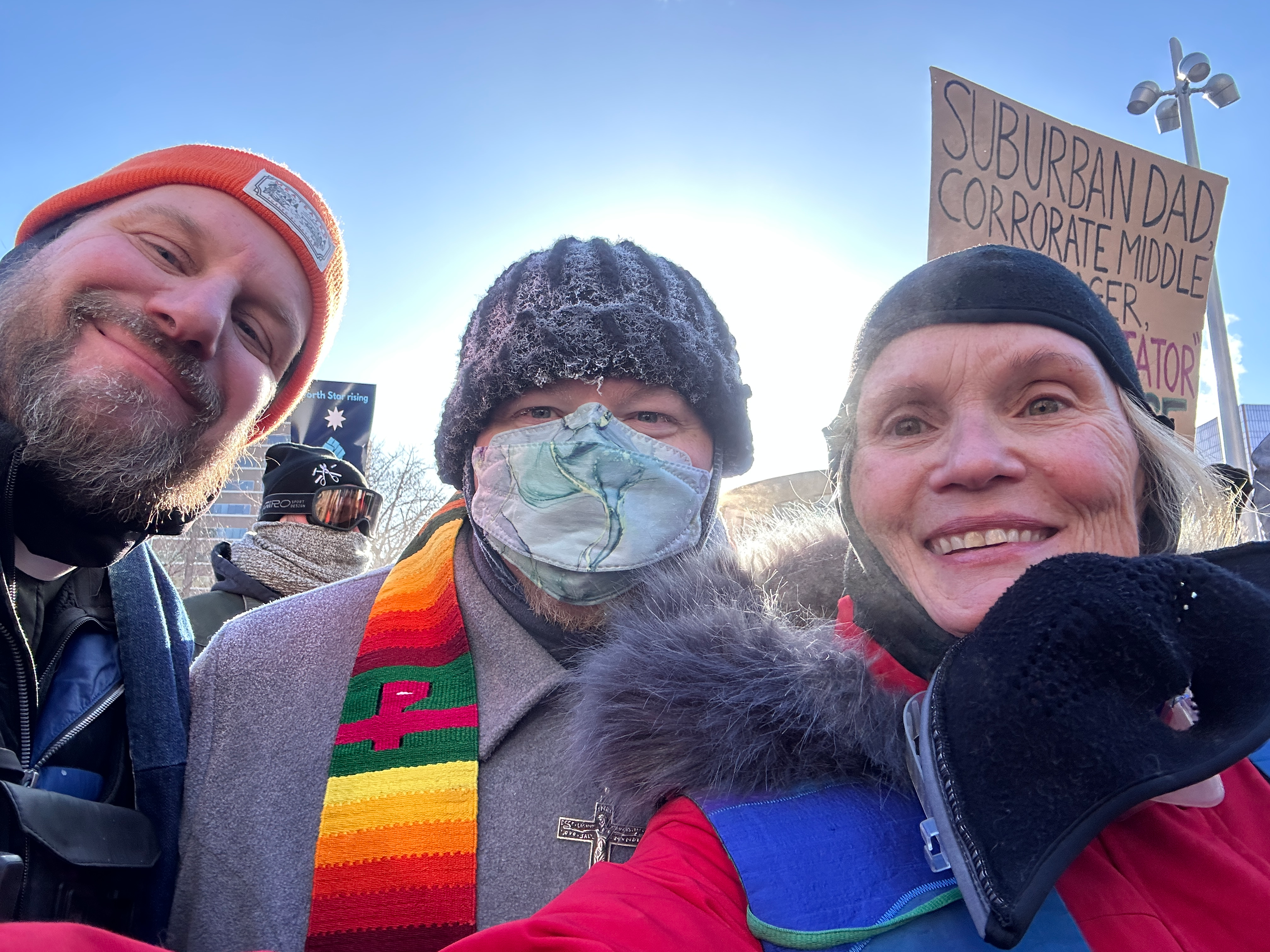 thousands who had come to stand against the brutality, cruelty, and lawlessness of the federal occupation of this once-peaceful city. While there, I received a text warning that federal agents might use water cannons on protesters – which, of course, in that type of cold, would be deadly. I put my phone away, donned my make-shift tear-gas mask, and joined my colleagues as we headed out the door.
Singing “This Little Light of Mine,” we left the church and merged with thousands entering from every direction. The crowd was so massive that it took nearly an hour for those of us gathered at the starting point to fully enter the march. We moved slowly, navigating ice-covered streets before surging forward into the march itself.
Despite the bitter cold, which with windchill was about -35, nothing could dampen the fervor of the protesters or quiet our voices. We  called for ICE to leave Minnesota. We spoke aloud the name of Renee Good, killed by an ICE agent. We named Liam Ramos, a five-year-old child used as bait by ICE to lure out his family before being sent with his father to a prison in Texas. We demanded justice, accountability, and an end to the occupation.
It is impossible to describe the joy I felt seeing so many people there – 50,000, we were told. For most, this 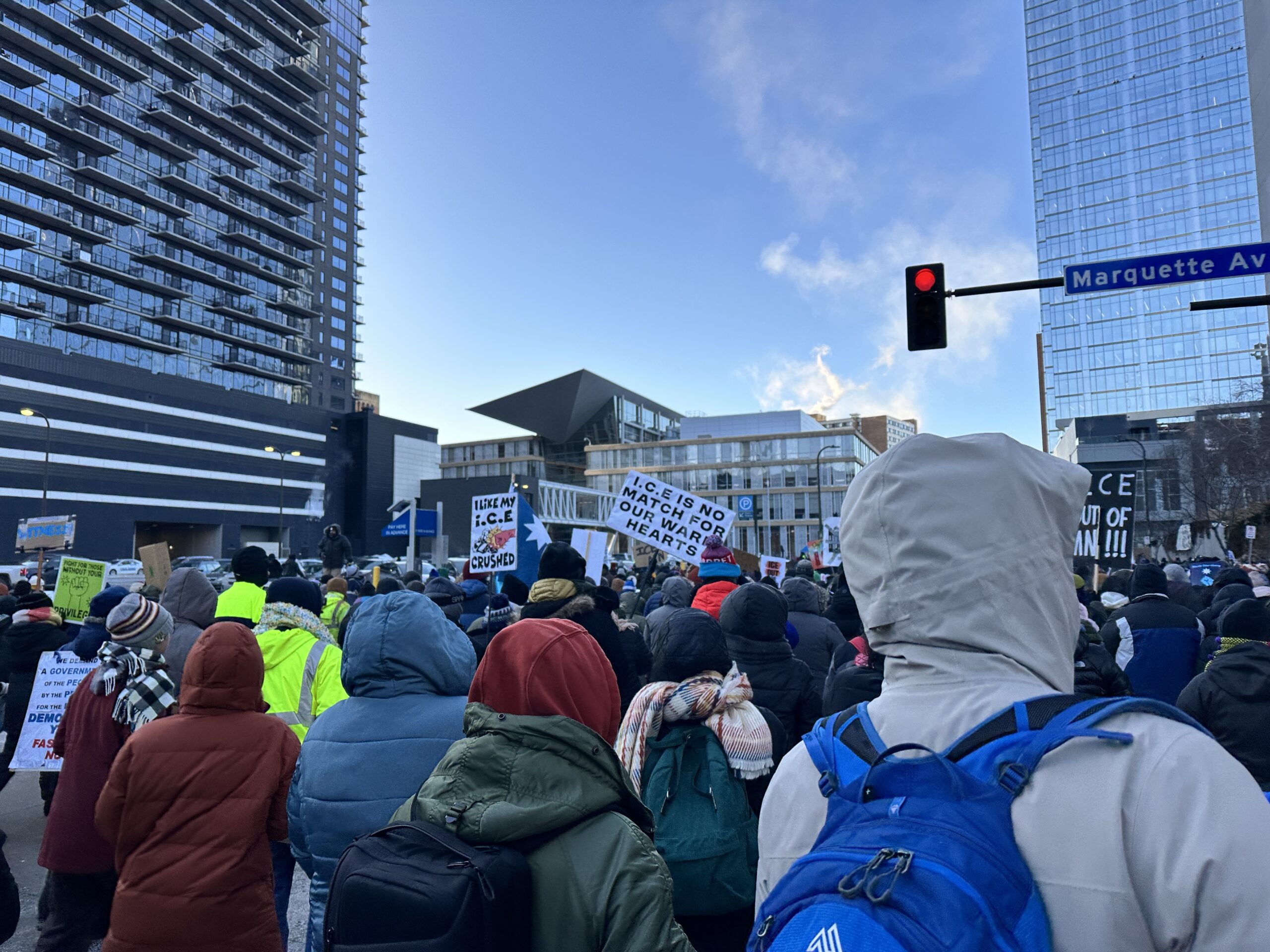 was not a single day of action. They were living this resistance daily: patrolling neighborhoods to warn of federal agents, distributing food to those unable to leave their homes, and caring for one another. Clergy tended their people, preaching the gospel in both word and deed. I was surrounded by prophets – exhausted, unwavering, and deeply inspiring.
When I could no longer feel my feet with a quarter mile left to go, their courage carried me forward. People passed out hand warmers and tissues. Two marchers ahead of me wore backpacks reading, “If you are hungry, tap my 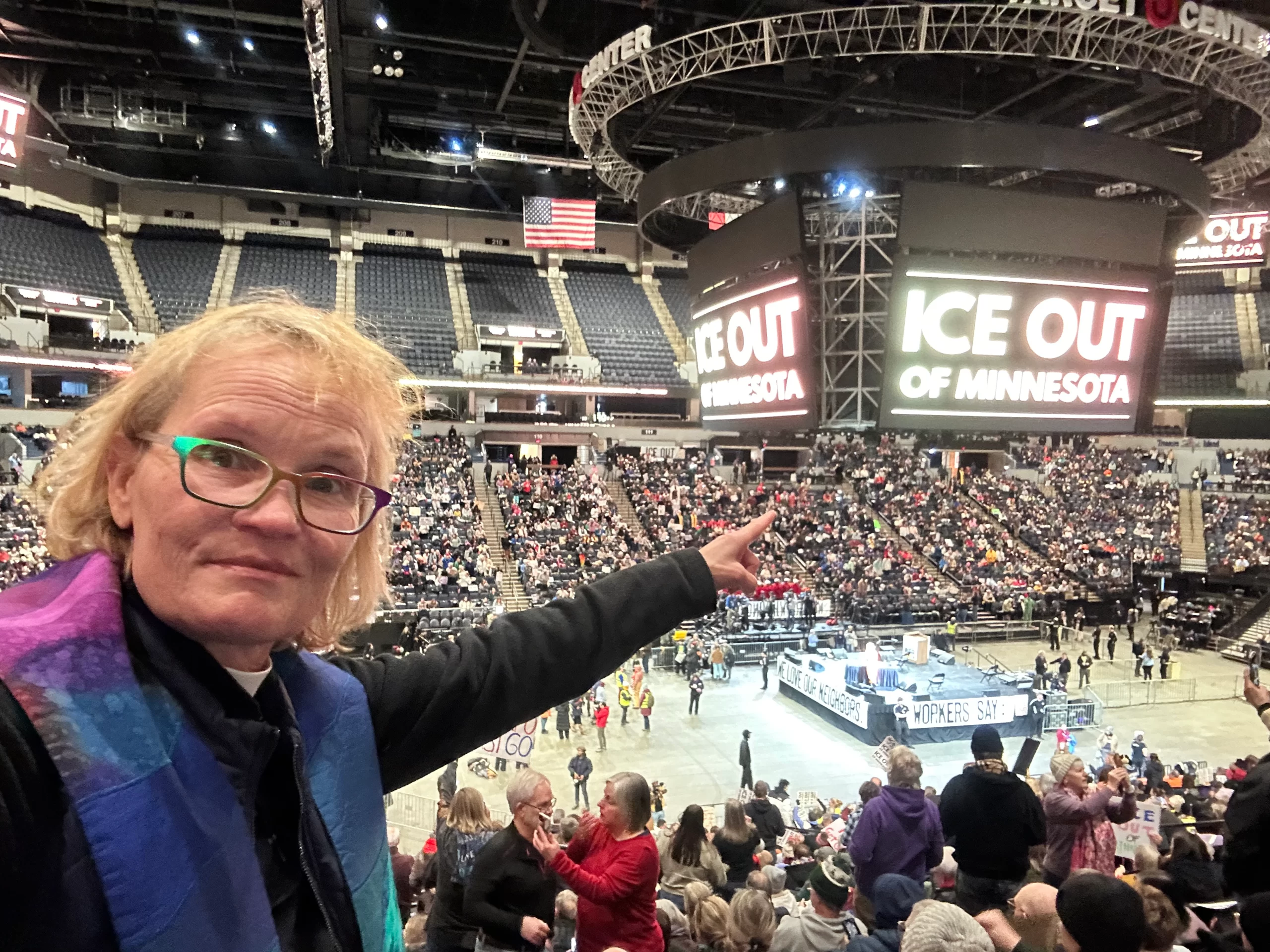 shoulder,” and “If you need hand warmers, tap my shoulder.”
Even in anger and pain, Minnesotans chose to meet hate and violence with compassion, grace, and love.
At the rally, which thankfully had been moved inside, faith leaders proclaimed that God’s love is greater than any hate this government can unleash. And, indigenous leaders reminded us that no one is illegal on stolen land.
Walking back through deserted streets, I passed the statue of Mary Tyler Moore tossing her hat into the air in an iconic moment of liberation. It is from a TV show that some of a certain age 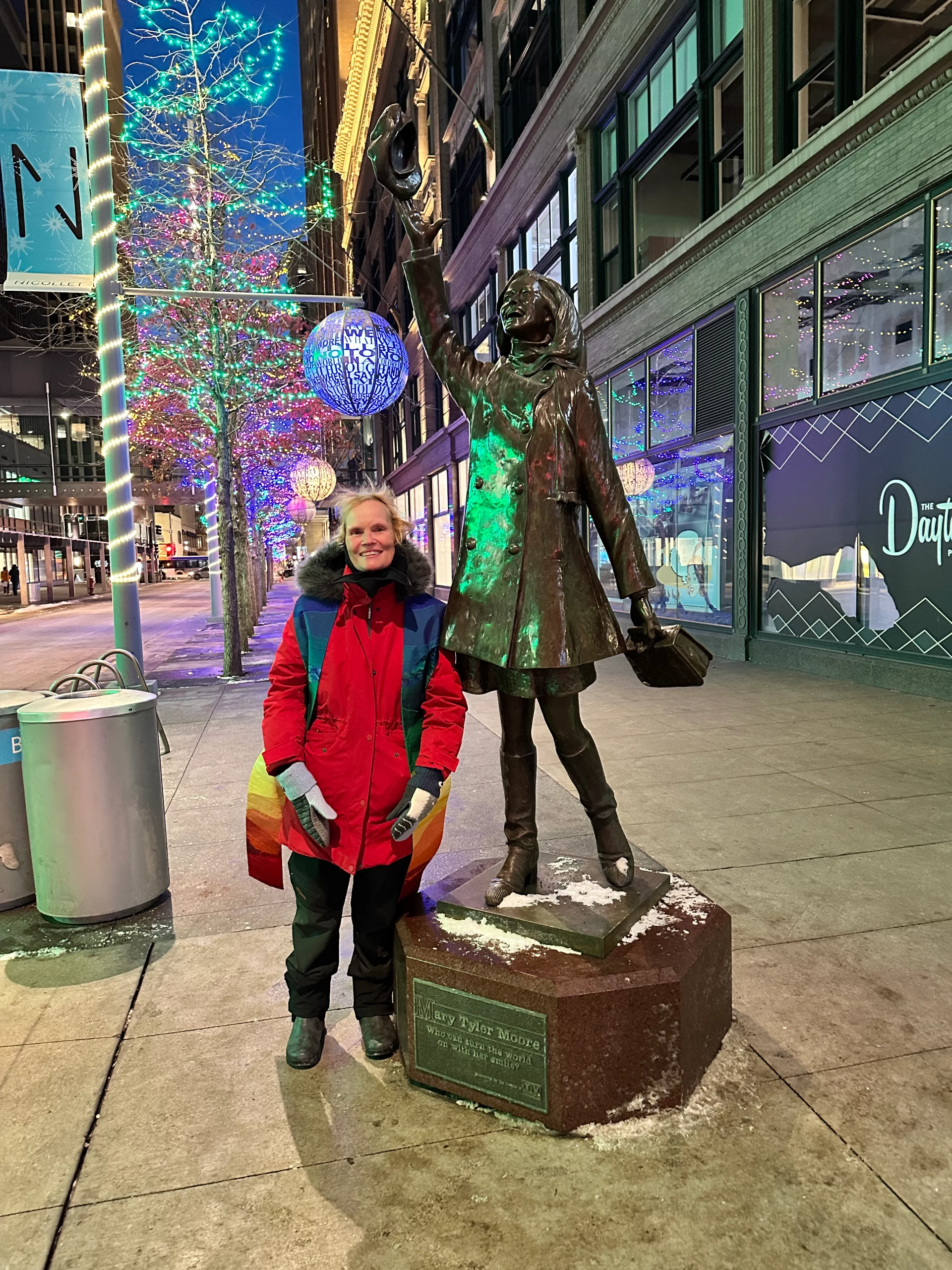 remember well. The theme song’s title came to my mind: “Love Is All Around,” and I thought – it sure was that day. I went back to my hotel believing, as the song says, that we’re “gonna make it after all.”
I flew out the next morning, later learning that as I traveled above the city, below Alex Pretti was being beaten and killed by Federal agents. Does that mean it was all for nothing? Not at all. It means the struggle continues, and those of us who are able must keep answering the call of Christ – to be the light that enlightens the nations – our nation – even to the cross. To bring the knowledge of the gospel to those who need it most. The ones who govern – that they may turn from their evil acts against our neighbors, and live the law of God – to love one another, and to care for the least of these. And the ones being oppressed – that they may know that they are loved, and they are not alone or forgotten – not by God, and not by any of us.
That is our faith and it will change the world, but it will not be easy, and it will pierce our own hearts too. It was reported yesterday that an ICE agent told a protestor “If you raise your voice, I will erase your voice.” I kid you not.
But let me be perfectly clear – they can try to erase our voice – but we will only grow louder, because no ICE agent, or anyone else, can ever erase the voice of Jesus. Lord knows, and he does, the Romans tried that long ago in the most brutal way. It didn’t work then, and it won’t work now.
Christ showed the world that God’s love is stronger than human hate, and Christ’s light will always overcome the darkest of humanity in the end. So, in the days ahead, we will with our voices and our actions show the world that God’s love is all around, and I promise you, that if we do that – we will make it after all.
Amen.
For the audio, click below, or subscribe to our iTunes Sermon Podcast by clicking here (also available on Audible):
The Rev. Diana L. Wilcox
Christ Church in Bloomfield & Glen Ridge
February 1, 2026
Feast of the Presentation (trans.)
1st Reading – Malachi 3:1-4
2nd Reading – Hebrews 2:14-18
Gospel – Luke 2:22-40